Equity index futures play a critical role in the U.S. financial markets. Instruments like S&P 500 futures, Nasdaq-100 futures, and Dow Jones futures are widely traded by institutions and retail traders alike due to their liquidity, leverage, and efficiency. However, trading these instruments manually has become increasingly challenging as markets grow faster and more competitive.
This has led to a surge in demand for a reliable algorithmic trading app—one that can automate execution, enforce discipline, and handle the complexity of equity index futures trading with precision.
This article explores how equity index futures trading works in the U.S., why automation is becoming essential, and what traders should look for in a modern algorithmic trading app.

What Are Equity Index Futures?
Equity index futures are derivative contracts that allow traders to speculate on the future value of a stock market index. Instead of trading individual stocks, traders gain exposure to the overall market or a specific sector through a single instrument.
In the U.S., the most actively traded equity index futures include:
- S&P 500 Futures
- Nasdaq-100 Futures
- Dow Jones Futures
- Russell 2000 Futures
These contracts are widely used for:
- Directional trading
- Hedging equity portfolios
- Short-term speculation
- Systematic and quantitative strategies
Their standardized structure and high liquidity make them ideal for algorithmic trading.
Why Manual Trading Struggles in Equity Index Futures
Equity index futures react instantly to:
- Macroeconomic data releases
- Interest rate expectations
- Global market movements
- Institutional order flow
Manual traders often face:
- Delayed execution during volatile moves
- Emotional decision-making
- Inconsistent risk management
- Difficulty monitoring multiple timeframes
As a result, many traders turn to automation to improve execution quality and consistency.
Why Algorithmic Trading Fits Equity Index Futures
Algorithmic trading aligns naturally with equity index futures because:
- Futures markets are highly liquid
- Pricing is transparent
- Volatility follows identifiable patterns
- Execution speed is critical
An effective algorithmic trading app ensures that trades are executed based on predefined logic, not emotion, allowing traders to participate systematically in fast-moving futures markets.
Key Features of a Good Algorithmic Trading App
For U.S. traders focused on equity index futures, an algorithmic trading app should provide the following:
Strategy Automation
The ability to automate entries, exits, stop-losses, and profit targets without manual intervention.
Backtesting Capability
Traders must be able to test strategies on historical U.S. futures data to evaluate performance across market conditions.
Low-Latency Execution
Fast and reliable execution is essential, especially during high-volatility sessions.
Risk Management Controls
Position sizing, daily loss limits, and strategy-level risk parameters should be built in.
Cloud-Based Reliability
Strategies should run continuously without requiring local systems or constant monitoring.
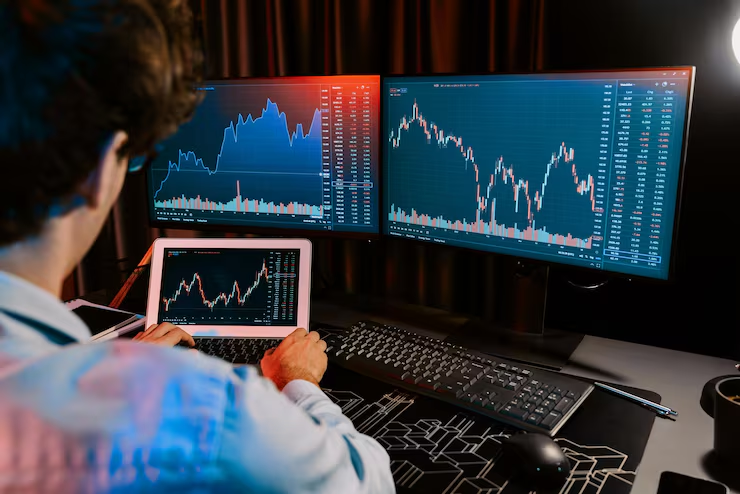
How Tradetron Functions as an Algorithmic Trading App
Tradetron is a global no-code algorithmic trading platform that supports traders in the U.S. by enabling automated execution across multiple asset classes, including equity index futures.
Key strengths of Tradetron include:
- No-code strategy creation using a visual interface
- Backtesting tools for evaluating futures strategies
- Automated execution through broker API integrations
- Cloud-based strategy deployment
- Risk controls at both strategy and portfolio levels
Tradetron allows traders to convert futures trading ideas into automated systems without the complexity of traditional programming environments.
Common Algorithmic Strategies Used in Equity Index Futures
Some widely used algorithmic approaches in U.S. equity index futures include:
Trend-Following Algorithms
Designed to capture sustained directional moves during high-volatility periods.
Breakout Strategies
Focus on price expansion beyond key support and resistance levels.
Mean Reversion Models
Target short-term pullbacks within broader trends.
Time-Based Execution Algorithms
Trade specific sessions such as the market open or closing hour where liquidity is highest.
These strategies rely on automation to ensure accurate and timely execution.
Who Should Use an Algorithmic Trading App?
An algorithmic trading app is particularly suitable for:
- Futures traders seeking consistency
- Traders managing multiple strategies
- Professionals looking to remove emotional bias
- Retail traders transitioning from discretionary trading
Automation does not eliminate risk, but it improves process efficiency and execution discipline.
Conclusion
Equity index futures trading in the U.S. has evolved into a speed-driven, data-intensive activity where manual execution often falls short. To remain competitive, traders increasingly rely on automation to execute strategies with precision and discipline.
Choosing the right algorithmic trading app is therefore a strategic decision. Platforms like Tradetron provide the tools needed to automate, backtest, and manage equity index futures strategies in a structured and scalable manner.
For traders focused on long-term consistency rather than short-term reactions, automation is becoming an essential component of futures trading success.
Frequently Asked Questions (FAQs)
1. What are equity index futures?
Equity index futures are contracts that allow traders to speculate on or hedge against movements in stock market indices like the S&P 500 or Nasdaq-100.
2. Why is automation important for equity index futures trading?
Automation improves execution speed, consistency, and risk control in fast-moving futures markets.
3. What is an algorithmic trading app?
An algorithmic trading app is a platform that automates trade execution based on predefined rules and strategies.
4. Can retail traders use algorithmic trading apps in the USA?
Yes. Retail traders in the U.S. can use algorithmic trading apps through compliant brokers and API-based platforms.
5. How does Tradetron help futures traders?
Tradetron enables traders to automate, backtest, and manage equity index futures strategies using a no-code, cloud-based platform.






Be First to Comment