
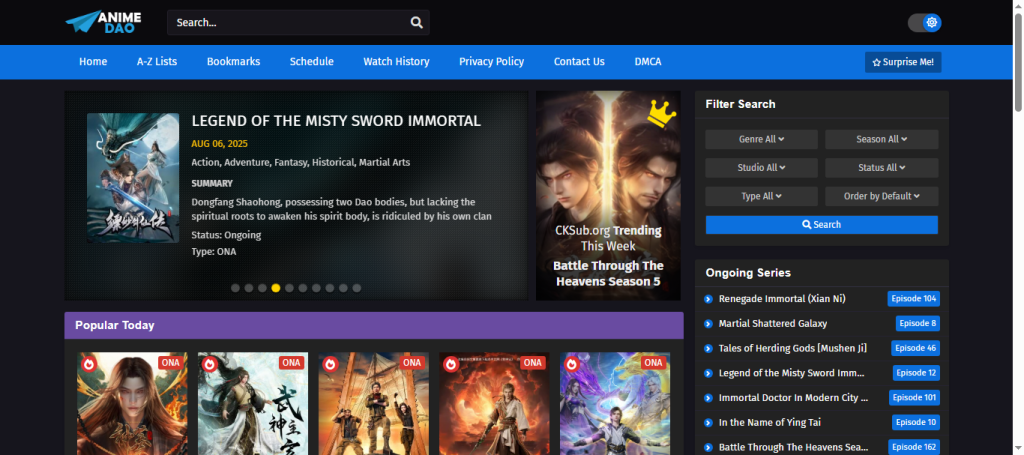
AnimeDao is a free online anime streaming website that has attracted millions of viewers with its large catalog of titles. Its official homepage (https://animedao.watch/home/) touts a “massive library” of anime series and movies – covering action, romance, fantasy, and more – available with both Japanese subtitles and English dubs. The site emphasizes a “user-friendly interface” and promises high-quality video without any subscription fees. In practice, the it’s homepage presents a simple grid of episode thumbnails (as shown above) where recent episodes of popular series (e.g. Jujutsu Kaisen, My Hero Academia) are listed by title and episode number. According to the site’s own feature list, it boasts an “extensive anime library” across all genres, offers both subtitled and dubbed versions, and claims “no subscription required”. While convenient for viewers, these claims should be viewed in context: It is not an official streaming service and operates outside normal licensing agreements.
How does it work?
It’s website interface displays recent episodes in a grid layout with cover art and episode titles, making it easy to browse the latest releases. The site advertises a “vast library” of free anime in many genres, with options for English-dubbed or Japanese-subbed viewing. All content is presented on-demand via embedded video players. As a free, ad-supported platform, it does not require user registration or payment – it explicitly states “no subscription required”. In practice, users can navigate the site, click on any listed episode, and start streaming immediately. The service also markets features like bookmarks and content notifications to track favorite shows (although detailed account features are limited). It offers a Netflix-style anime browsing experience for free, albeit with advertising and shortened or altered domain names (see below).
It has proven extremely popular with fans seeking free anime. In 2023 it was one of the highest-trafficked anime sites worldwide. Analytics data show that it drew roughly 18–19 million visitors per month in early 2023. For example, SimilarWeb reports ~19.1 million visits in April 2023, 18.1 million in May, and 16.9 million in June. In total, the site recorded over 54 million visits during that three-month span. These numbers put AnimeDao.watch on par with other big pirate anime sites. The chart below (from SimilarWeb) illustrates this traffic trend:
Traffic data for Anime Dao (April–June 2023) reveals about 19.1M visits in April, 18.1M in May, and 16.9M in June. These tens of millions of monthly visits reflect the site’s massive popularity among anime fans worldwide. (AnimeDao’s audience was especially large in the United States, which was by far its top source of traffic.)
Over the years it has frequently changed domains and web addresses. Its operators regularly switch URLs to stay online, as the site itself warns: its .to and .com domains have been “shut down” or blocked, and new official domains (such as , animedao.bz, animedao.us, etc.) appear periodically. For example, the prominent animedao.to domain was taken down on July 20, 2023. That shutdown followed direct legal pressure: in mid-2023 the Motion Picture Association (and the anti-piracy coalition ACE) obtained a U.S. court subpoena related to it’s operators. Faced with these subpoenas and possible legal consequences. It posted a farewell message and “threw in the towel”, officially halting new content on its platform. TorrentFreak reported that the site’s owners cited “financial, technical, and legal” reasons for closure and told users that content would no longer be available. Despite that, clones and proxy sites have since re-emerged under similar names, and the brand persists (the current domain is one such iteration). The constant domain changes and recent shutdown illustrate the unstable status of it.
Legal and Ethical Considerations
It is important to understand that it operates outside of legal licensing. The anime on AnimeDao is not provided by official distributors, and the site does not hold copyright permission from the Japanese rightsholders. Industry groups and anti-piracy coalitions thus classify it as a pirate streaming platform. Indeed, the Motion Picture Association’s Alliance for Creativity and Entertainment (ACE) targeted the site along with other anime pirate networks. According to TorrentFreak, it’s extensive traffic (tens of millions of visits) was a key factor drawing this legal scrutiny. The site itself skirted the issue by claiming to be “safe” and “legal”, but admits in its FAQ that questions about legality arise. In reality, streaming on sites like AnimeDao violates copyright law.
Piracy of anime has serious impacts on the industry. A 2023 study by Japan’s Content Overseas Distribution Association found that Japanese anime and manga lost nearly 2 trillion yen (≈ US$19.7 billion) in 2022 to global online piracy. These losses represent revenue that would otherwise support creators, studios, and local licensors. In response, Japanese publishers, studios, and governments are cooperating internationally to crack down on piracy. It is part of the target: for instance, the same ACE/MPA actions that led to it’s shutdown also shut down the top pirate site Zoro.to (largest anime pirate) around the same time.
From an ethical standpoint, using it means enjoying content without compensating the creators or the anime industry. While fans may be tempted by its free access and quick episode updates, the cost to the community is real. Moreover, unofficial sites carry user risks. It is funded by advertising, which often involves intrusive pop-ups or redirects. The site itself states it “does not host or distribute viruses” but warns that third-party ads may not be safe. In practice, clicking ads on such sites can expose users to malware or scams (a known issue with many pirate streaming sites). In contrast, official services like Crunchyroll or Netflix are ad-free or use trusted ad networks.
While it provides a convenient gateway to free anime, it is illegal and carries ethical and security concerns. Industry experts advise viewers to support official streaming when possible. Legitimate platforms pay licensing fees that fund new anime production and ensure creators are rewarded. For example, Crunchyroll – a joint venture of Sony Pictures Entertainment and Aniplex – has acquired licenses for thousands of shows. Crunchyroll announced it surpassed 15 million paid subscribers in 2024, helping to grow legal anime distribution. Using official sites (even their free or ad-supported tiers) means contributing to the industry. By comparison, it’s model shortchanges the creators whose work viewers enjoy.
Comparison with Other Streaming Platforms
It is one of many ways fans can watch anime online, but it occupies a very different space from mainstream platforms. Leading legal anime services include Crunchyroll (Sony/Aniplex), Funimation (also Sony), Netflix, Hulu, Amazon Prime Video, and others. These services acquire regional or global streaming rights for anime series and movies, and they charge subscription fees or use familiar ad models. For instance, Crunchyroll’s library now exceeds 50,000 episodes (over 25,000 hours), including simulcasts of new shows directly from Japan. Netflix has also invested heavily, producing exclusive anime and securing titles for its global audience.
The paid platforms typically offer high-definition video, reliable performance, and multiple language options. Crunchyroll even offers a free, ad-supported tier on its website where registered users can watch many shows legally (albeit with limited content and commercials). Similarly, Hulu or Amazon may have some anime in their catalogs. In Asia, services like Ani-One or regional apps may offer free legal anime with ads. Additionally, free legal alternatives exist. For example, Anime-Planet partners with Crunchyroll and HIDIVE to stream thousands of anime episodes with permission, at no cost to users.
By contrast, AnimeDao.Watch (and its peers like 9Anime, GogoAnime, AnimeHeaven, etc.) is a purely free service with no registration or fees. This makes it immediately accessible anywhere (aside from any country blocks). It also tends to update shows very quickly. Often as soon as an episode airs in Japan (one advantage pirate sites tout). In practice, its interface is very lightweight and fast-loading compared to some heavy ad-driven sites. However, the trade-off is legality and reliability. Official sites occasionally delay releases in certain regions due to licensing. Pirate sites like AnimeDao face sudden shutdowns (as happened in 2023), forcing users to hunt for new domains or alternatives. They also bombard users with ads (even if it claims “minimal ads”, ads are still present).
In summary, AnimeDao.watch offers quick, free access and a massive archive of anime, but it’s essentially a pirate operation. The legal streaming services – Crunchyroll, Funimation, Netflix, etc. – require payment but offer safety, quality, and industry support. Other free pirate alternatives (9Anime, GogoAnime, etc.) share Anime Dao’s risks. Fans who care about legality and quality will generally prefer official platforms, while those prioritizing immediacy and cost sometimes use sites like it, often at the risk of malware or legal trouble.
Safety Tip When Accessing it
Sometimes, when clicking links on it’s homepage, users may be redirected to unrelated or suspicious websites. This is a common issue with free streaming platforms that rely on ads. If this happens, simply close the unwanted tab and return to the official homepage: https://animedao.watch/home/. Always verify the URL before browsing to ensure you are on the correct site.
Conclusion
AnimeDao represents the double-edged sword of free anime streaming. It fills a demand by providing an enormous, easily browsable anime library (including English-dubbed content) at no cost, as illustrated by its tens of millions of monthly visitors. Its interface is clean and user-friendly, and it updates frequently. However, this convenience comes at a price: It is not legally authorized, and using it contributes nothing to the creators or the industry that makes the anime fans love. The Japanese anime industry’s heavy losses to piracy mean that unauthorized sites like it are targeted by international anti-piracy efforts, which is why its operators have repeatedly lost domains and even shut down sections of the site.
For the anime community, the key takeaway is to weigh the pros and cons. AnimeDao and similar sites can be used (at one’s own risk) to find and watch shows that might otherwise be inaccessible, but they carry ethical and security downsides. Whenever possible, supporting official streaming platforms not only provides the best reliability and quality, but also ensures creators are supported. Services like Crunchyroll, Funimation, Netflix, Hulu, and others offer a legal way to watch most popular anime, even if they sometimes require subscriptions or have regional restrictions. Ultimately, knowing the differences helps viewers make informed choices: it can satisfy short-term curiosity, but its long-term sustainability and safety are dubious. Fans who value the future of the anime industry will consider official alternatives and use free pirate sites only with caution.










Be First to Comment