Background and Development: Pac-Man was created by Toru Iwatani and a small Namco team in 1979 and released in Japan on May 22, 1980. Originally titled Puck Man (from the Japanese onomatopoeia paku-paku for “gobbling”), the name was changed to Pac-Man for the U.S. release to avoid vandalism of arcade cabinets. Iwatani deliberately designed a nonviolent game aimed at a broader audience than the war and sports shooters of the time. He drew inspiration from a pizza with a slice removed (forming Pac-Man’s simple round shape) and made the maze and characters cute and colorful to appeal even to women and younger players. This approach was innovative: as one Google designer noted decades later, Pac-Man “stood out as one of the first video games aimed at a broader audience,” featuring a “pizza-shaped character gobbling dots in a maze” and “very little violence”.
Gameplay Mechanics and Design
Pac-Man is a classic maze-chase game. The player moves Pac-Man around a fixed maze, eating all the small dots (pellets) while being pursued by four colored ghosts. Unique features of the gameplay include:
- Maze and pellets: Pac-Man must clear the maze by eating every dot.
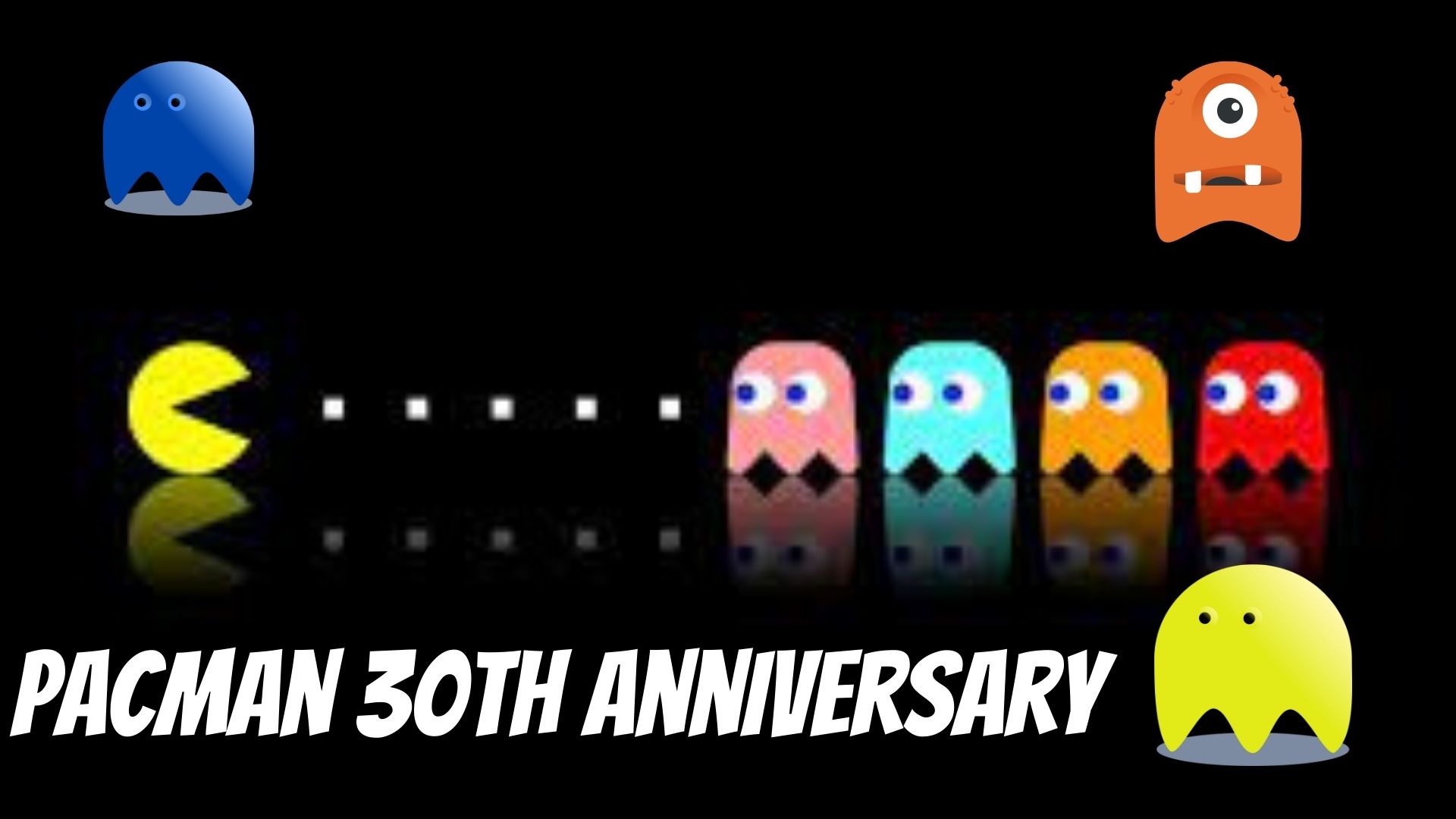
- Four ghost enemies: The ghosts Blinky (red), Pinky (pink), Inky (cyan), and Clyde (orange) each have distinct AI behaviors – for example, Blinky relentlessly chases Pac-Man, while others try to ambush or alternate chasing and fleeing.
- Power pellets (energizers): Four large flashing dots in the maze corners turn the ghosts blue when eaten, allowing Pac-Man to consume the ghosts for bonus points. After being eaten, a ghost’s eyes return to the “ghost house” in the center to regenerate.
- Warp tunnels: Two passages on the sides of the maze allow Pac-Man (and the ghosts) to teleport from one side of the screen to the other, adding a tactical escape route.
- Kill screen: The game steadily speeds up, and due to a programming limitation it produces a garbled, unbeatable “kill screen” on the 256th level – a famous glitch caused by an integer overflow.
These elements – especially the simple dot-eating goal, the memorable ghost characters with personalities, and the energizer-powerup dynamic – gave Pac-Man a gameplay feel unlike anything that had come before.
Cultural Impact in the 1980s
Pac-Man quickly became a pop-culture phenomenon. By the early 1980s, Pac-Man merchandise and media were everywhere. There were Pac-Man breakfast cereals on grocery shelves, a Saturday-morning cartoon series featuring Pac-Man and his family, and even a novelty song “Pac-Man Fever” on the radio. One commentator observed that when Pac-Man arrived, it “blew onto the scene with a scale of cultural impact that video games, already an international phenomenon, had never previously achieved”. The bright, nonthreatening design helped Pac-Man cross over: Namco’s president even said the game appealed so broadly that it became the company’s official mascot. Millions of arcade machines were sold worldwide, making Pac-Man (along with its offshoot Ms. Pac-Man) one of the highest-grossing arcade games ever. In the 1980s, Pac-Man could be seen on T-shirts, lunchboxes, watches, and many other products. Its name and maze design became shorthand for video games themselves; to this day, the descending ghosts of Space Invaders and the Pac-Man mouth icon are commonly used symbols for gaming. In short, the game’s popularity spawned extensive sequels and merchandise – from two animated TV series to a hit single “Pac-Man Fever” – cementing Pac-Man’s status as a global icon.
Read more about: Betweenle A Unique Word Puzzle Game
Merchandise, Sequels, and Influence
The Pac-Man craze naturally led to many official spin-offs and imitators. The most famous spin-off was Ms. Pac-Man (1982), developed by a third party and published by Namco; it introduced a female protagonist, added new maze designs and moving bonus items, and was itself one of North America’s best-selling arcade games. (In fact, Pac-Man and Ms. Pac-Man remain the two most successful arcade machines in history.) Namco and Midway released other sequels throughout the 1980s, including Super Pac-Man (1982), Pac-Man Plus (1982), Jr. Pac-Man (1983), Baby Pac-Man (1983), and even a trivia-based Professor Pac-Man (1984). Further sequels explored new ideas: Pac-Mania (1987) was an isometric-view maze, Pac-Land (1984) had side-scrolling platform gameplay, and Pac-Attack (1993) was a falling-block puzzle game. In 1999, Pac-Man went 3D in the adventure Pac-Man World. In the 2000s and 2010s, Namco revisited Pac-Man for modern platforms: notably Pac-Man Championship Edition (2007) on Xbox Live Arcade, which won acclaim for its fast-paced neon style. That game’s success spawned Pac-Man Championship Edition DX (2010) and Pac-Man Championship Edition 2 (2016). By 2020 there were well over 200 official Pac-Man releases in total.
This influence extends to other games, too. Pac-Man helped define the maze-chase genre and showed how to make game characters feel alive with personality. Its design – where Pac-Man’s only collision with objects stands for “eating” instead of violent death – was praised as a clever shift that made players empathize with the character. Other designers have pointed out that Pac-Man’s universal theme of consuming dots is human and nonviolent, contributing to its timeless appeal. In every era since, game designers have borrowed Pac-Man’s tricks: friendly mascots, power-ups, and patterned enemy behavior are now common features in many titles.
30th Anniversary Celebrations (2010)
In May 2010 Pac-Man turned 30, and the celebrations were widespread. The most famous tribute was Google’s playable homepage doodle on May 21, 2010. Google transformed its logo into the full Pac-Man maze, letting users insert virtual coins and play the game directly in their web browser. Players could press “Insert Coin” to start a single-player game (using the arrow keys to move Pac-Man). Inserting a second coin let a second player take control of Ms. Pac-Man with the WASD keys. The doodle reproduced the original game’s logic, graphics, and even bugs, and it remained live for 48 hours on the Google homepage. Google later reported that this Pac-Man doodle had been played over one billion times worldwide in 2010.
You may also like: Kick.com Streaming Platform
Namco’s own celebrations included new game releases and events. At trade shows and public events, Namco showcased Pac-Man Battle Royale (an arcade version allowing up to four simultaneous players) and a special Pac-Man’s Arcade Party cabinet containing 12 classic Namco games (including Pac-Man and Ms. Pac-Man). This multi-game “anniversary cabinet” was sold in late 2010 as a way to bring retro classics into arcades and game rooms. That year Namco also released Pac-Man Championship Edition DX for Xbox 360 and PlayStation 3, updating Pac-Man with new mazes and neon visuals. Online fan events appeared too: for example, in April 2011 a browser game called World’s Biggest Pac-Man was launched (a collaboration with Microsoft) letting players create enormous, interconnected Pac-Man mazes online as part of the 30th anniversary festivities. In summary, the 30th anniversary was marked by both high-profile tributes (like Google’s doodle) and by Namco actively refreshing the brand for a new generation.
Legacy and Continued Relevance
Pac-Man’s influence did not stop in 2010 – the game remains a recognized symbol of gaming today. The franchise has continued to expand with modern releases. For example, in recent years Bandai Namco released Pac-Man Geo (a smartphone game that turns real city maps into Pac-Man mazes) and Pac-Man: The Card Game. In 2020 Google’s Stadia streaming platform launched Pac-Man Mega Tunnel Battle, a battle-royale style take on Pac-Man. Pac-Man frequently appears in crossover promotions and new media. In 2023, Namco teamed up with Mediatonic to put Pac-Man and one ghost (Inky) as costumes in the popular online game Fall Guys. The brand also crosses into toys: Lego released a detailed “PAC-MAN Arcade Machine” building set in 2023, complete with brick models of Pac-Man and ghosts on a functioning arcade cabinet. (Even on April Fool’s Day 2017, Google celebrated Pac-Man with a playable version in Google Maps.)
Final words
Beyond official products, Pac-Man continues to enjoy mainstream recognition. The character appears in movies (such as the 2015 film Pixels), TV shows, and memes. Longtime fans and new players alike encounter Pac-Man on modern platforms – the original game has been ported to countless consoles, computers, and phones, often bundled with other classics. High-score competitions still attract attention (even achieving the perfect 3,333,360-point score is a famous feat in gaming circles). Game designers regularly cite Pac-Man’s impact; it is often listed among the “greatest video games of all time” with a lasting legacy.
Pac-Man’s 30th anniversary was a milestone that both honored the past and highlighted the game’s ongoing life. From its humble start as a maze game about eating dots, Pac-Man evolved into a cultural icon with a legacy of sequels, merchandise, and influence on game design. Thirty years on, Pac-Man remains as beloved and relevant as ever, still gobbling pellets and inspiring players around the world.




[…] The Pacman 30th anniversary game is a downloadable version of the original game that offers 255 levels and two-player modes. It features two-player options in which both players can control different Pac-Men at the same time. The objective of this maze-chasing video game is to collect as many dots as possible, avoid ghosts, and avoid obstacles while avoiding the ghosts. […]
[…] Also read: Pacman 30th anniversary […]
[…] read: Read also: It is now possible to enjoy Pac-Man games thanks to the enormous success of the game on Google Doodle as […]
[…] acknowledgment, Pac-man, Pacman 40th recognition, Pacman 30th festival, Pac-man 40th acknowledgment, Pacman 31st recognition, ms Pacman 31st acknowledgment, Pacman 25th […]
[…] of these games that are well-known referred to as Pacman Doodle, is offered for online play via Google Doodle. additionally, an outsized variety of players are […]
[…] Read more: Pacman 30th anniversary […]
[…] also: It is now possible to enjoy Pac-Man games thanks to the enormous success of the game on Google Doodle as […]
[…] Read also: Pacman 30th anniversary […]
[…] Besides appealing ghosts, the sounds in the game are also very attractive that induce the player to keep on playing. There are some fruit bonuses in the game as well that further enhance the attraction of the player towards the game. In the Pacman 30th anniversary, all the characters of the game including ghost so appreciated a lot.Read also: It is now possible to enjoy Pac-Man games thanks to the enormous success of the game on Google Doodle as well Pacman. […]
[…] Read also: It is now possible to enjoy Pac-Man games thanks to the enormous success of the game on Google Doodle as well Pacman. […]
[…] also: It is now possible to enjoy Pac-Man games thanks to the enormous success of the game on Google […]
[…] If you’re looking for ways to earn a little extra cash in PUBG Mobile, you might want to consider selling robux in the Robuxstore. You can sell items in the store for in-game bucks, or you can complete offers and surveys to earn Robux. This is a good option if you’re looking to make a little money on the side, but it’s important to remember that robux are not a viable option for everyday use. […]
[…] also: It is now possible to enjoy Pac-Man games thanks to the enormous success of the game on Google Doodle as […]
[…] Pacman 30th Anniversary – Few Tips Reviewed […]
[…] multiple thoughts blowing real elements? Explore our infographics! Despite merriments on the web, pacman 30th anniversary darlings can in like manner throw more than one festivities. Pacman is model to the factor that […]